






Science fiction is often defined as being about technological progress and often projects a future in which the moral arc of history bends toward computational and scientific mastery. Alternately, it might showcase a future brought to ruin because of what technological progress, coupled with social or cultural has wrought. And that’s usually the whole story: one quick snapshot of time where everything is exploding (see: my novel Sublimation, which I’m contractually obligated to mention whenever possible).
I, however, want to talk about speculative evolution, a microgenre where time ebbs and flows and society and technological progress and intelligence and sapience itself rises and falls with the centuries, and the thing we call a “human being” or a “person” just gets weirder and weirder. The first well-known instance of this microgenre is Last and First Men by Olaf Stapledon, published in 1930, which charts the history of humanity over the next two billion years, with the rise and fall (and various offshoots) of “Men.” Since 1930, there have been a number of other novels that develop on this premise or aspects or the premise, some of which I have collected for your perusal here today.
I’ve specifically curated this list to follow a narrow criteria. The books need to be about human evolution, in which human cell stock is either manipulated by other humans or by an alien lifeform, and it needs to at least partially focus on the effects of the manipulation, and the long-term effects.
Though, if I’m being honest, this is at least a partially vibes-based list, and I had a secret agenda. My hope is by exposing you to this microgenre, I will inspire you to read the books I’ve listed, and then to also write a book about speculative human evolution. Because then I’ll get to read it.
And there are some pretty obvious criticisms with this microgenre: It can be a platform to describe a very biased projection of the future as if it is fact. It tells a story of what the future might hold as filtered through the author’s own societal prejudices in the time period it is being written. It can edge into eugenics. But at its best, this microgenre is a love letter to deep time, to the persistence of biological life in an uncaring universe, and to the belief that intelligence and sentience and love and personhood and society can be reassembled across deep time.
Anyway, I love this weird little microgenre of novel. I love the weird, gross anatomy. I love the genuine stabs at biological plausibility around how a human being, after millennia of time, might end up looking something like a porpoise or anteater. I love how arrogant this genre of novel is, and I love how imaginative it can be.
And it’s fun to imagine ourselves as one bead on a grand chain of lifeforms, slowly evolving into the next. Did I say fun? I meant weird and unsettling. But life is weird and unsettling. So, you know, just try to have fun, and enjoy the billions-of-years ride.
Man After Man: An Anthropology of the Future by Dougal Dixon
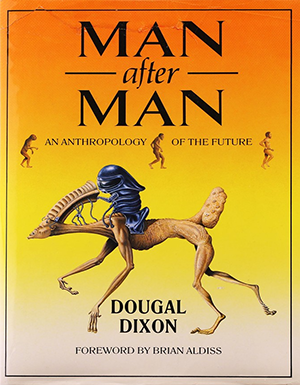
If you can get your hands on a copy of this bad boy, it’s got some of the most powerful illustrations known to man (after man). Notice that I didn’t say good. I suppose they’re technically well rendered, but, well, a lot of these drawings are unsettling, and a little gross, and slightly disturbing. And they’re supposed to be weird! Written more like an encyclopedia than having a single narrative thread, Man After Man imagines what human-derived organisms and species might look like after years of evolution and manipulation, both inflicted by time and by genetic engineering, as human beings speciate into various branches of “type of animal” after the Earth becomes moderately uninhabitable and people take to the stars and the seas and the forests.
Also, it’s the origin of the Seasons Greasons meme, if you’ve seen that.
All Tomorrows: A Billion Year Chronicle of the Myriad Species and Mixed Fortunes of Man by C.M. Kösemen
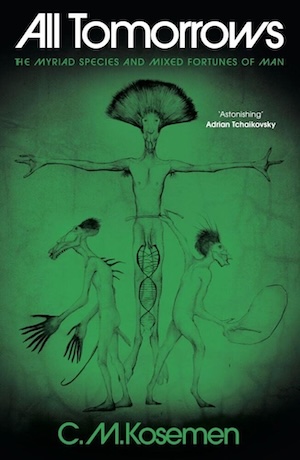
All Tomorrows is Man After Man, but with aliens. Whether that makes it better or worse is really a matter of personal preference. The artwork is just as unsettling, there’s more of a hint of a storyline, and the things that happen to humanity are done with more intention (aliens) and are crueler (also because of the aliens). That being said, the ultimate arc of history in All Tomorrows is also more uplifting than in Man After Man, with the eventual message that the universe bends toward iterations of civilization and sentience, one after another. In a weird way, it’s remarkably optimistic. Even though every single human and human-derivative is dead at the end.
Evolution by Steven Baxter
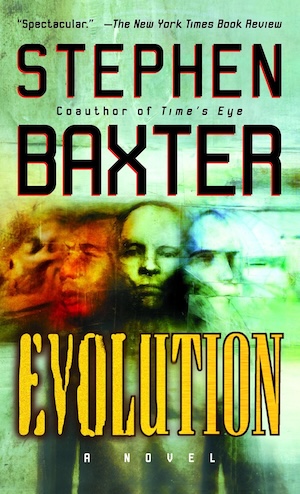
Evolution, unlike the other entries on this list, considers the deep past along with the far future. It presents quick snippets of high drama from the various organisms that inhabited the earth before us (dinosaurs, little tiny rodents, various hominids etc) before turning toward the organisms that currently inhabit the earth (us) and the organisms that inhabit it after. Zero weird illustrations. Occasionally very dry. Moderately depressing at points. I still enjoyed it quite a bit, and it’s very science fiction science fiction.
Children of Time Series by Adrian Tchaikovsky
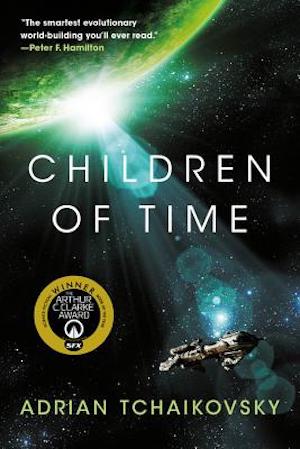
Now we shift gears to a series containing a plot with some actual density beyond following the lineage of humanoid evolution. There are other ways to describe it, but for our purposes: Children of Time and its sequels follow the consequences of introducing an uplift nanovirus to various organisms on various planets (including humans) in what I can only describe as a post-earth-cataclysm future. While each book in these series contains an actual plot throughline, many sections are devoted to describing the speedrun of evolution across the various animals (and humans), and how the various species, all seeded by human intervention, end up cooperating.
Runaway to the Stars by Jay Eaton
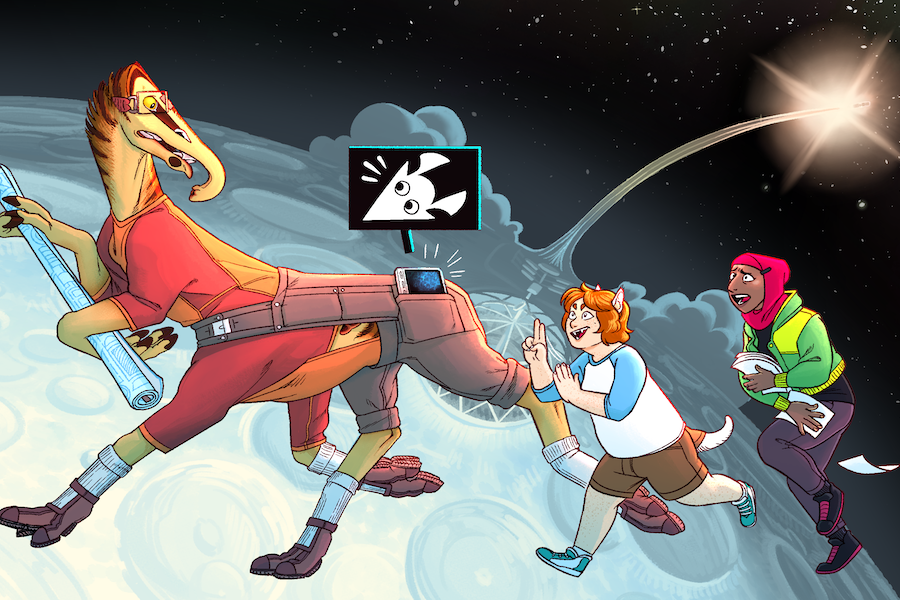
Unlike everything else on this list, Runaway to the Stars is (a) a hard science slice of life webcomic, (b) incomplete (though Iron Circus Comics will be printing the first bound volume, according to Jay Eaton’s website), and (c) focused on xenobiology as well as human evolution. In fact, the human evolution takes a backseat to the xenobiology, but I’ve included it here because the intersection of human culture, genetic modification, and rigorously described xenobiology is really delightful, and I think it’s in the spirit of the project that I’ve set upon myself here today. Look, I told you it was a vibes based list. I get to choose the vibes. And the vibes I’m choosing are “centaur (not what you’d think) anatomy.”
Buy the Book

Sublimation

First and Last Men seems an obvious sixth book
“My hope is by exposing you to this microgenre, I will inspire you to read the books I’ve listed, and then to also write a book about speculative human evolution. Because then I’ll get to read it. “
Isn’t that one of the main reasons ReacTor writers create lists like this?
Harry Harrison’s “Final Encounter” (1964) had a diverse assortment of human-descended explorers encounter what they thought at first glance were aliens. In fact, the “aliens” were also hominids, transformed by life on a hostile planet and a lot of time.
I wonder what evolutionary purpose is served by the Vitruvian Man’s pixelation? Other species of hominids appear to lack that.
Darwin’s Radio and Darwin’s Children by Greg Bear both deal with first steps into the next phase of human evolution. Radio is somewhat horrific, since the start of the book deals with investigating an epidemic of a new retrovirus that seems to be killing pregnant women. I reread Radio as an audiobook a couple of years ago, and I’m not sure how well it held up, feeling very late 90s.
You could almost argue that a good portion of the original Dune series explored human evolution. There is the straightforward breeding program of the Bene Gesserit and the cloning by the Bene Tleilax. Then there are the Guild Navigators, and the people around them. While the Mentats are products of dedicated training, I’m sure there are lineages that have evolved to be more suited to be Mentats. And then there is Leto II of course.
This kind of book normally squicks me out a bit, but I did unexpectedly love “Children of Time” when I read it for a book club a couple years ago. I haven’t successfully gotten anyone ELSE to read it just yet (“The spiders are really okay! They’ve got Shakespearean names!”) but I find myself thinking about it at least once a week.
People seem to love or hate the Red Rising series (I’m in the love camp). The later books get into human adaptations from living on outer planets and moons which I found super interesting.
And shoutout to Dawn by Octavia Butler, and the other two books in that series.
How about A.E. van Vogt’s “Slan”? Or John Wyndham’s “Rebirth” (sorry; I chose the USAian title)?
James Blish wrote a terrific novel comprising four novellas called Surface Tension, which is (of course) estremely well written, and it’s one of my favorites. Clarke’s The City and the Stars and Against the Fall of Night dealt with human evolution over a billion years or two. Jack Vance wrote at least two, The Dragon Masters and The Last Castle. Larry Niven’s Known Space has multiple instances: human breeding by the Puppeteers for luck, intervening also to produce less violent Kzinti, and the evolutionary explosion of humans created by the disappearance of the Pak on Ringworld. I’m sure there are a ton more…
currently reading the Lilith’s Brood series by Octavia Butler, and that seems to fit the “vibe”.